12th & 13th centuries

Jingdezhen's bluish white
Before its celebrated blue-and-white vessels, Jingdezhen made Qingbai porcelain with a pale, bluish glaze. It reached Japan, Southeast Asia and East Africa.
Following the Carving on a Qingbai BottleThree objects in museum collections trace its journey across cultures.
12th & 13th centuries
Before its celebrated blue-and-white vessels, Jingdezhen made Qingbai porcelain with a pale, bluish glaze. It reached Japan, Southeast Asia and East Africa.
Following the Carving on a Qingbai Bottle14th century

Jingdezhen potters refined clay recipes and firing methods during the Yuan dynasty. Their blue-and-white vessels travelled widely, including to the Middle East, and inspired makers abroad.
Chinese porcelain in museums16th to 18th centuries

From the 16th century, growing European trade brought new commissions to Chinese potteries. By the 18th, personalised services bore their owners' coats of arms.
A Portuguese coat of arms, painted in Jingdezhen
Jiangxi, China
A thousand years of porcelain making
Clay, kilns and generations of skilled hands made Jingdezhen a centre of porcelain production. Its vessels travelled from Chinese homes and imperial courts to collections around the world.
That history continues in the painted vessels and coloured glazes made here today.
Shaped by hand, finished in detail, transformed by heat.
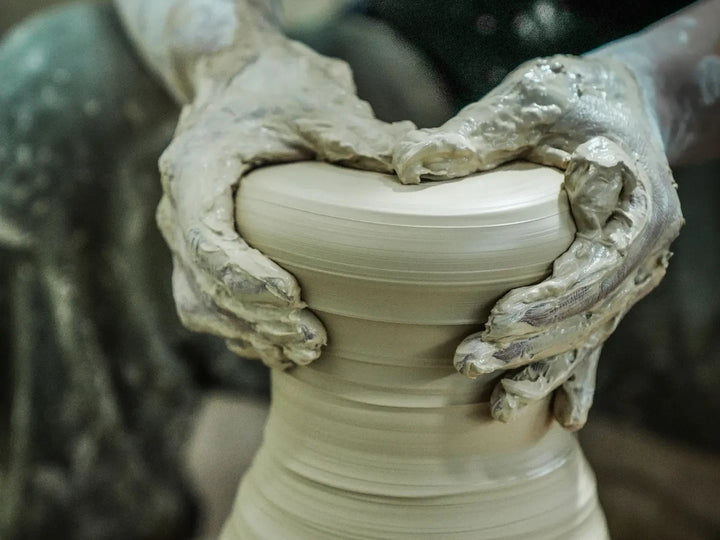
Wet clay takes shape between the hands.

A patterned surface, worked by hand.

Inside a traditional brick kiln.

Cobalt painting beneath a clear glaze.

Colour painted in overglaze enamels.

Reticulated patterns and openwork.

Colour, surface and the shape beneath.
Contemporary pieces selected for their vessel shapes, painted detail and references to historical porcelain.

Fujian, China
Blanc de Chine and porcelain sculpture
In Dehua, decoration can be shaped into the porcelain itself: the folds of a robe, a raised peony, a lotus opening around a stick of incense.
Our selection brings figures and flower-covered vessels together with smaller pieces for daily use.

Figures in white porcelain and coloured finishes, from Dehua.

Dehua vessels with flowers and foliage modelled in relief.

Sculpted porcelain for incense and fragrance rituals.
White porcelain and coloured finishes, across sculpture, vessels and tea.
Colour takes the lead in Longquan celadon and contemporary Ru-style ware.

Green glazes shaped by the traditions of Longquan, Zhejiang.

Contemporary pieces inspired by the soft blue glazes of historical Ru ware.

A window into Chinese porcelain.
Chinese porcelain deserves a place in everyday life, not only in the world's great collections.
We founded Azure Blanc to bring its history, living craft and contemporary pieces into view. Through our Journal, kiln guides and considered collection, we invite you to understand Chinese porcelain, explore its traditions and find a piece to live with.
Our StoryFor the room, the tea table and the small rituals of a day. Find a piece by the place it will occupy or the way you will use it.


Tea passes from the gaiwan to a sharing pitcher, then into the cups. The painted porcelain is part of each movement.
Colour and form on a smaller scale.

Two chrysanthemums turn across the ivory surface of a shallow Ding ware plate. Made in the Jin period, it retains a hand-cut design as moulded decoration became more common.
More museum stories
A plate's border deserves to be seen. How to choose a viewing position and a suitable support, with a closer look at stands, wall mounts and adhesive hangers.
More on living with porcelain
A practical reading of reproduced reign marks on contemporary Chinese porcelain, separating the inscription from production date and origin.
More on objects & collecting


